WakeOS
Secure remote infrastructure for hotels, PBX systems, Raspberry Pi appliances, and distributed business networks, powered by the WakeWolf automation engine.
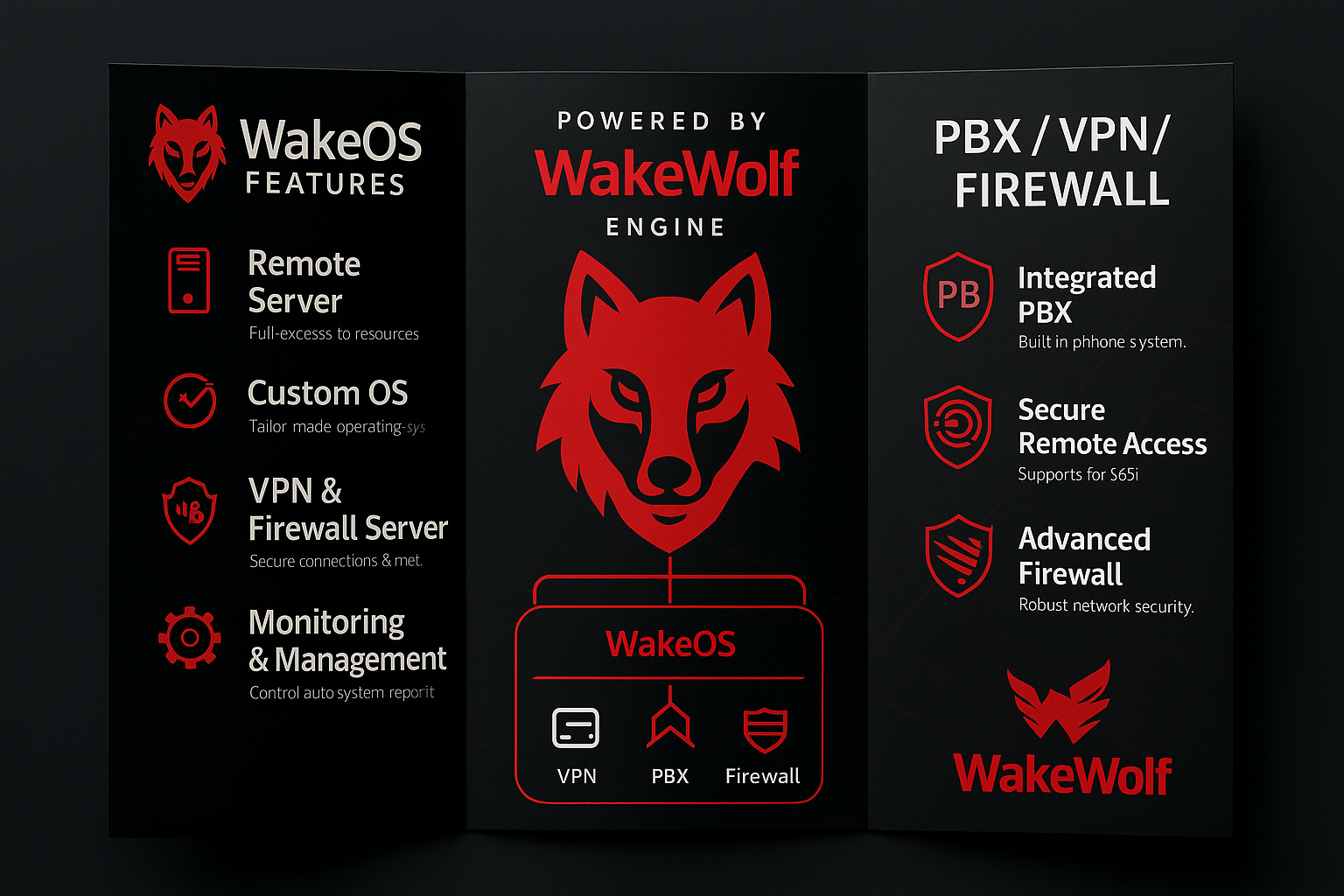
WakeOS core capabilities
WakeOS combines remote access, private networking, firewall hardening, PBX visibility, serial access, and system monitoring into one managed platform.
Remote server access
Reach customer systems without port forwarding, with WakeDesk available as the managed remote-access module.
Zero Trust VPN
Use Tailscale/WireGuard style private networking between sites, technicians, servers, and field appliances.
Advanced firewall
Hardened Linux firewall controls with room for future WakeGuard policy automation and threat response.
PBX monitoring
Support hospitality and legacy voice environments, including Mitel/SIP-focused monitoring and access workflows.
Serial bridge
Bridge RS232 and console-style systems to IP for remote support of legacy equipment at customer sites.
Device monitoring
Track CPU, memory, disk, uptime, network health, and service availability for managed WakeOS nodes.
Automation and monitoring below the desktop layer.
WakeWolf is the engine layer behind WakeOS for policy enforcement, infrastructure monitoring, deployment automation, and future intelligent remediation.
WakeDesk is the remote access layer inside the WakeOS ecosystem.
WakeDesk provides licensed remote desktop access for Windows, Linux, Raspberry Pi, and WakeOS hosts. It connects through your private WakeDesk server while WakeOS handles the broader appliance, VPN, firewall, PBX, and monitoring story.
Control Remote Desktop
 Linuxoffice-linux
 RPisite-rpi-01
 Windowsfront-desk-pc
Built for field deployments
Start with WakeOS appliances and add WakeDesk, VPN, firewall, monitoring, PBX, and serial support based on the customer site.
Raspberry Pi appliances
Deploy compact WakeOS nodes for remote access, monitoring, VPN, and site-level support.
Hospitality and PBX
Support hotel environments, voice systems, and business networks through one managed appliance.
Managed operations
Use server-side licensing, dashboards, node status, and support workflows to operate customer fleets.